 AI Knowledge Tree
Positional encodings
Compare sinusoidal, learned, ALiBi, and RoPE positional encodings, and see why position must be injected into self-attention.
Self-attention is permutation-equivariant: shuffle the tokens and the output rows shuffle the same way. Without position information, the Transformer cannot tell "the cat sat on the mat" from "the mat sat on the cat". Positional encodings inject position into the representation. Four flavors dominate: sinusoidal (the original), learned, ALiBi, and RoPE. Modern LLMs all use one of the latter two.
Why position matters
Multi-head self-attention is computed via , which depends only on the set of tokens, not their order. A Transformer with no positional information cannot distinguish word orderings, which destroys language modeling.
Three places to add position information:
- Absolute positions added to token embeddings before the first layer.
- Relative positions injected into attention scores at every layer.
- Rotational positions applied to queries and keys before computing attention.
Each approach has a different generalization profile to sequence lengths longer than training.
Sinusoidal positional encoding
The original Transformer: a fixed function of position, no parameters[1].
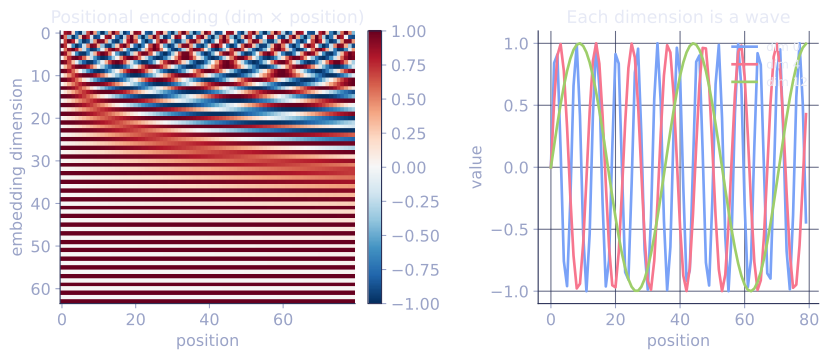
Each dimension of the encoding is a sinusoid at a different frequency. Added to the token embedding before the first Transformer block.
Properties:
- Different positions get different vectors.
- can be expressed as a linear function of for any fixed , so relative positions are representable.
- Generalizes (in principle) to positions longer than training, since the function is defined for any .
In practice, vanilla sinusoidal does not extrapolate well: the model overfits to seen positions and generalization to unseen lengths is poor.
Learned positional embeddings
Used in BERT, original GPT, ViT. A learnable vector per position:
Simple, slightly more flexible than sinusoidal at trained positions, but fixed maximum length and zero generalization past it.
ALiBi (Attention with Linear Biases)
Press et al. (2022). Add a position-dependent bias directly to the attention scores:
with a per-head slope (different across heads). Tokens at distance get penalized by , so closer tokens get more attention than far ones.
No learned parameters, no embeddings to add. Generalizes to longer sequences than training because the bias is purely a function of distance.
RoPE (Rotary Position Embedding)
Su et al. (2021)[2]. The standard in LLaMA, GPT-4-class models.
Apply a position-dependent rotation to the query and key vectors before the attention dot product. For pairs of dimensions :
with matching the sinusoidal frequencies.
The crucial property: the attention dot product becomes , a function only of the relative position . RoPE is relative positional encoding implemented via rotations.
Properties:
- No added parameters (no learned embedding table).
- Naturally encodes relative position.
- Generalizes modestly to longer contexts; with NTK scaling or YaRN extensions, can be retrofitted to 2-4x training length.
RoPE is the de facto default for new LLM architectures. Combined with its scaling extensions, it has displaced both sinusoidal and learned absolute embeddings.
Practical recipe
- BERT-style encoders for fixed-length text: learned positional embeddings are fine.
- ViT: learned 1D or learned 2D positional embeddings.
- Decoder-only LLMs with potential context extension: RoPE plus one of its scaling extensions (YaRN, NTK).
- Long-context experimentation or position generalization is critical: ALiBi.
The choice rarely affects accuracy by more than 1-2% at the same context length, but greatly affects how well the model generalizes to longer contexts than it saw at training.
Check it on arrays
import numpy as np

# Sinusoidal positional encoding
def sinusoidal(N, d):
    pe = np.zeros((N, d))
    pos = np.arange(N)[:, None]
    div = np.exp(np.arange(0, d, 2) * -(np.log(10000.0) / d))
    pe[:, 0::2] = np.sin(pos * div)
    pe[:, 1::2] = np.cos(pos * div)
    return pe

PE = sinusoidal(N=32, d=8)
print(f"sinusoidal PE shape: {PE.shape}")
print(f"PE(0): {PE[0].round(2)}")
print(f"PE(1): {PE[1].round(2)}  (close to PE(0) by linear shift)")

# RoPE: apply position-dependent rotation
def rope(x, position):
    d = x.shape[-1]
    theta = 10000.0 ** (-np.arange(0, d, 2) / d)         # theta_i = 10000^(-2i/d), with np.arange(0,d,2) = 2i
    cos = np.cos(position * theta)
    sin = np.sin(position * theta)
    x_even = x[..., 0::2]; x_odd = x[..., 1::2]
    out = np.empty_like(x)
    out[..., 0::2] = x_even * cos - x_odd * sin
    out[..., 1::2] = x_even * sin + x_odd * cos
    return out

# RoPE preserves rotational invariance: dot product depends only on relative position
rng = np.random.default_rng(0)
q = rng.normal(size=8); k = rng.normal(size=8)

for pq, pk in [(0, 0), (0, 5), (3, 8), (10, 15)]:
    q_rot = rope(q, pq); k_rot = rope(k, pk)
    print(f"pos_q={pq}, pos_k={pk}, relative={pk-pq}: q_rot . k_rot = {q_rot @ k_rot:.4f}")

# ALiBi bias for a small attention matrix
def alibi_bias(N, slope):
    distances = np.abs(np.arange(N)[:, None] - np.arange(N)[None, :])
    return -slope * distances

bias = alibi_bias(N=5, slope=0.5)
print(f"\nALiBi bias matrix (slope=0.5):")
print(bias.round(2))
The RoPE dot product depends on (pk - pq), not absolute positions; the ALiBi bias matrix is a function of distance only.
Exercises
Exercise 1. For model dimension , compute the sinusoidal positional encoding rows and by hand. Recall and . Use , , , .
Solution
Step 1. With there are two frequency pairs, and . The denominators are for and for .
Step 2. At every argument is , so the sines are and the cosines are : .
Step 3. At , dimension uses argument and dimension uses argument :
The low-index dimension (high frequency) changes fast between positions and , while the high-index dimension (long wavelength) barely moves; that spread of frequencies is what lets the encoding distinguish both nearby and distant positions.
Exercise 2. RoPE rotates dimension pairs by angle and its key property is that depends only on the relative position . For a single 2D pair with , take and . Show that the rotated dot product at equals the one at by hand. Use .
Solution
Step 1. Rotating by angle gives ; rotating by gives . Their dot product is .
Step 2. At the relative position is , so .
Step 3. At the relative position is again , so .
Both pairs give the same value because the rotation reduces the dot product to a function of alone; absolute positions cancel.
Exercise 3 (code). Verify the RoPE relative-position invariance in numpy: for random query and key vectors, the rotated dot product is equal across all position pairs sharing the same offset . Build the attention score for several offsets and assert that shifting both positions by the same amount leaves each score unchanged.
Solution
import numpy as np

rng = np.random.default_rng(0)

def rope(x, position):
    d = x.shape[-1]
    theta = 10000.0 ** (-np.arange(0, d, 2) / d)
    cos = np.cos(position * theta); sin = np.sin(position * theta)
    x_even, x_odd = x[..., 0::2], x[..., 1::2]
    out = np.empty_like(x)
    out[..., 0::2] = x_even * cos - x_odd * sin
    out[..., 1::2] = x_even * sin + x_odd * cos
    return out

def score(q, k, pq, pk):
    return rope(q, pq) @ rope(k, pk)

q = rng.normal(size=8); k = rng.normal(size=8)

# Same offset (pk - pq = 4) at three different absolute placements
s_a = score(q, k, 0, 4)
s_b = score(q, k, 3, 7)
s_c = score(q, k, 10, 14)
assert np.isclose(s_a, s_b) and np.isclose(s_a, s_c)

# A different offset gives a genuinely different score
s_other = score(q, k, 0, 5)
assert not np.isclose(s_a, s_other)
print("offset 4 scores:", round(s_a, 4), round(s_b, 4), round(s_c, 4))
print("offset 5 score: ", round(s_other, 4))
The three offset-4 scores match to floating-point precision while the offset-5 score differs, confirming RoPE encodes relative position and discards the absolute placement.
The next lesson introduces an alternative to attention entirely: state space models.
References
- [1]Vaswani, A., et al. (2017). "Attention is all you need". NeurIPS. arXiv:1706.03762. The original sinusoidal positional encoding.↩
- [2]Su, J., Lu, Y., Pan, S., Wen, B., & Liu, Y. (2021). "RoFormer: enhanced transformer with rotary position embedding (RoPE)". arXiv:2104.09864. Encodes relative position by rotating queries and keys.↩