 AI Knowledge Tree
Induction heads
Identify the two-head induction circuit (previous-token head + induction head) that implements in-context learning; show how ablating it destroys few-shot performance.
Induction heads (Olsson et al., 2022) are specific attention heads that implement a primitive form of in-context learning[1]: if the pattern appears in the context, an induction head at the second predicts as the next token. This mechanism generalizes to sequences of tokens, enabling the model to copy and extend patterns from anywhere in the context.
The task: in-context pattern completion
Consider the context:
...the cat sat on the mat...the catAt the final "cat", the model should predict "sat" (completing the repeated phrase). This requires attending back to the earlier occurrence of "cat" and reading the token that followed it. An induction head does exactly this.
The two-head circuit
Induction is implemented by two attention heads working in sequence, a composition the circuits framework makes precise[2]:
1. Previous-token head (layer ): for each position , copies the embedding of the previous token into the residual stream at position . After this head, position contains information about the token (in addition to the token itself).
2. Induction head (layer ): for each position with current token , looks for positions where the previous token was also (using the information written by the previous-token head). Attends to those positions and reads their current token (the token after the previous in context).
Context:  [the] [cat] [sat] ... [the] [cat]
                                       ↑
            Previous-token head writes [the] info at this position.
            Induction head finds earlier [the][cat] → predicts [sat].
Detecting induction heads
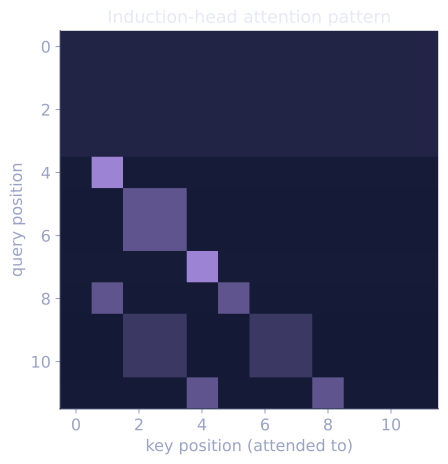
Prefix matching score: run the model on repeated random tokens (e.g., ). An induction head will attend from position back to position , forming a below-diagonal band in the attention pattern.
import numpy as np

def softmax(x, axis=-1):
    e = np.exp(x - x.max(axis=axis, keepdims=True))
    return e / e.sum(axis=axis, keepdims=True)

def induction_score(attn_pattern):
    """
    Measure how strongly the attention pattern follows the induction diagonal.
    For repeated-token input of length 2T, the induction head attends to
    position t-T for each position t (the previous occurrence of the same token).
    attn_pattern: (T, T)
    Returns: scalar in [0, 1], higher = more induction-like.
    """
    T = attn_pattern.shape[0]
    if T < 4:
        return 0.0
    # For the second half of the sequence, the induction target is T//2 positions back
    half = T // 2
    scores = [attn_pattern[t, t - half] for t in range(half, T) if t - half >= 0]
    return float(np.mean(scores)) if scores else 0.0

def prev_token_score(attn_pattern):
    """Measure how strongly the pattern attends to the immediately preceding token."""
    T = attn_pattern.shape[0]
    scores = [attn_pattern[t, t-1] for t in range(1, T)]
    return float(np.mean(scores))

# Simulate a previous-token head
T = 8
prev_logits = np.full((T, T), -10.0)
for t in range(1, T):
    prev_logits[t, t-1] = 5.0
prev_logits[0, 0] = 5.0
prev_pattern = softmax(prev_logits)

# Simulate an induction head (for T=8 with T//2=4 half-period)
ind_logits = np.full((T, T), -10.0)
for t in range(T//2, T):
    ind_logits[t, t - T//2] = 5.0   # attend T//2 positions back
for t in range(T//2):
    ind_logits[t, 0] = 5.0          # first half: fallback to position 0
ind_pattern = softmax(ind_logits)

print("Previous-token head:")
print(f"  prev_token_score = {prev_token_score(prev_pattern):.3f}")
print(f"  induction_score  = {induction_score(prev_pattern):.3f}")
print("\nInduction head:")
print(f"  prev_token_score = {prev_token_score(ind_pattern):.3f}")
print(f"  induction_score  = {induction_score(ind_pattern):.3f}")
Induction heads and in-context learning
Olsson et al. (2022) found that:
-
Induction heads appear abruptly during training (a "phase transition") and are responsible for a sudden jump in in-context learning ability.
-
Ablating induction heads (setting their output to zero) reduces in-context learning performance dramatically: few-shot prompting becomes nearly as poor as zero-shot.
-
The same heads that copy patterns in synthetic repeated-token tasks also support abstract in-context learning (new task learning from examples) in natural language.
This is a strong claim: a specific, interpretable mechanism -- the two-head induction circuit -- is largely responsible for the emergent ability of in-context learning.
Generalization of induction
The induction head's core operation is:
"If the current context matches the beginning of a pattern I've seen before, continue that pattern."
This generalizes far beyond literal token copying:
- Fuzzy induction: attention to semantically similar, not just identical, tokens.
- Compositional induction: continuing patterns based on abstract categories (e.g., continuing "red: rouge, blue: bleu, green: ___" requires category-level induction).
- Algorithm induction: completing arithmetic patterns, code completions, logic chains.
These generalized forms involve more complex circuits built on top of the basic induction primitive.
Exercises
Exercise 1. Run a length- sequence of repeated tokens through a perfect induction head. For each query position in the second half, state which key position the head attends to and which token it therefore predicts as the next token. Verify the predictions reconstruct the second copy of the pattern.
Solution
Step 1. With period , the induction head at position in the second half attends to , the previous occurrence of the current token, and reads the token that followed it, namely the token at .
Step 2. Tabulate (positions -indexed, tokens at then repeated):
| query | token at | attends to | predicts token at |
|---|---|---|---|
| 4 | 0 | ||
| 5 | 1 | ||
| 6 | 2 |
Step 3. The predictions at positions are exactly the continuations of the second copy, so the induction head reconstructs the repeated pattern from the shifted-back attention plus a read of the following token.
Exercise 2. The two-head circuit needs the previous-token head in layer and the induction head in layer . Explain why the ordering is forced: what does the induction head read that only exists because the previous-token head ran first, and what would break if both lived in the same layer?
Solution
Step 1. The induction head matches the current token against positions whose previous token was also . That match key (the identity of the preceding token) is not present in a raw position's residual; the previous-token head is what writes "the token before me was " into each position.
Step 2. The induction head's query-key matching therefore depends on a feature produced by the earlier head. If both sat in the same layer they read the same input residual, so the induction head would query against positions that do not yet carry the previous-token information, and the prefix match would fail. The strict layer ordering is what lets the second head compose on the first head's output, the K-composition the circuits framework names.
Exercise 3 (code). Implement the two-head induction prediction directly. Build a repeated random pattern of period , give the induction head an attention pattern that sends each second-half query back one period, and assert that reading the token after each attended position reproduces the true continuation.
Solution
import numpy as np

def softmax(x, axis=-1):
    e = np.exp(x - x.max(axis=axis, keepdims=True))
    return e / e.sum(axis=axis, keepdims=True)

rng = np.random.default_rng(0)
half = 4
seq = rng.integers(0, 20, size=half)        # random pattern A B C D
tokens = np.concatenate([seq, seq])          # repeat it: length 8
T = len(tokens)

# Induction head: each second-half query t attends to position t - half.
logits = np.full((T, T), -10.0)
for t in range(half, T):
    logits[t, t - half] = 8.0
attn = softmax(logits)

# Predict the token AFTER the attended-to previous occurrence.
preds = [tokens[int(np.argmax(attn[t])) + 1] for t in range(half, T - 1)]
truth = list(tokens[half + 1:])              # actual continuation of the 2nd copy

assert preds == truth
print("induction predictions:", preds, "== truth", truth)
The head reproduces the continuation because the shifted-back attention plus a one-step read recovers "the token that followed the previous occurrence."
References
- [1]Olsson, C., et al. (2022). "In-context learning and induction heads". Transformer Circuits Thread. transformer-circuits.pub. The phase-transition and ablation results cited here.↩
- [2]Elhage, N., et al. (2021). "A mathematical framework for transformer circuits". Transformer Circuits Thread. transformer-circuits.pub. Formalizes the previous-token + induction-head composition.↩