 AI Knowledge Tree
Decoding strategies
Implement greedy, beam search, top-k sampling, nucleus (top-p) sampling, and temperature scaling; understand the quality-diversity tradeoff each controls.
A language model produces a probability distribution over the next token; decoding is the algorithm that converts this distribution into a sequence of tokens. Different decoding strategies make fundamentally different tradeoffs between output quality and diversity.
Greedy decoding
At each step, pick the most probable next token:
Greedy is fast and deterministic. It is suboptimal because a high-probability first token may lead to a poor overall sequence -- greedy commits to a choice before seeing the consequences.
Beam search
Maintain (the beam width) candidate sequences ("beams") simultaneously. At each step, expand every beam by all vocabulary tokens and keep the sequences with the highest cumulative log-probability:
Initialize: beams = [([BOS], 0.0)]
For each step t:
    candidates = []
    For each (sequence, log_prob) in beams:
        For each token v in top_K candidates:
            candidates.append((sequence + [v], log_prob + log p(v | sequence)))
    beams = top_k(candidates, k=beam_width)
Return: beam with highest log_prob / length_penalty
Length penalty: sequences tend to have lower log-probability as they grow (each token multiplies by a factor). A length penalty normalizes: .
Advantages: finds higher-probability sequences than greedy.
Disadvantages: computationally more expensive; tends to produce generic, high-probability outputs that are less diverse and sometimes less useful than sampling.
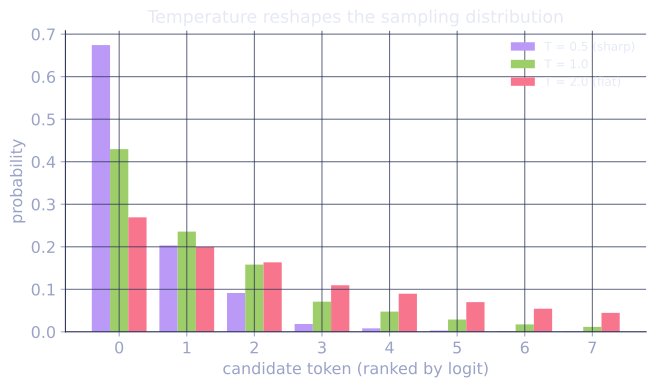
Temperature scaling
Before applying softmax, divide the logits by a temperature :
- : one-hot on the most probable token (greedy).
- : original model distribution.
- : flatter distribution, more diverse (but lower probability) outputs.
- : uniform distribution over vocabulary.
Temperature is the simplest diversity knob; typical values are 0.7-1.0 for generation tasks.
Top-k sampling
Sample from the most probable tokens, renormalized:
Top-k with is greedy; is unrestricted sampling. A fixed ignores the shape of the probability distribution: with , if the model is very confident (most mass on 1-2 tokens), you still sample from 50 tokens including many near-zero probability ones.
Nucleus (top-p) sampling
Top-p sampling / nucleus sampling (Holtzman et al., 2020) adapts the cutoff to the distribution shape: keep the smallest set of tokens whose cumulative probability exceeds [1]:
Sample uniformly from . When the distribution is peaked (model is confident), is small. When the distribution is flat (model is uncertain), is large.
Typical value: or .
Combined in practice
Production APIs typically combine temperature + top-p (or top-k). A common recipe: temperature , top-p -- temperature flattens the distribution, top-p cuts off the tail.
import numpy as np

def softmax(x):
    e = np.exp(x - x.max())
    return e / e.sum()

def temperature_scale(logits, T):
    return logits / T

def top_k_filter(probs, k):
    """Zero out all but the top-k probabilities."""
    idx = np.argsort(probs)[::-1]
    mask = np.zeros_like(probs, dtype=bool)
    mask[idx[:k]] = True
    filtered = probs * mask
    return filtered / filtered.sum()

def top_p_filter(probs, p):
    """Zero out probabilities below the nucleus cutoff."""
    sorted_idx = np.argsort(probs)[::-1]
    sorted_probs = probs[sorted_idx]
    cumsum = np.cumsum(sorted_probs)
    # Keep tokens until cumulative prob >= p
    cutoff_mask = cumsum - sorted_probs < p   # include the token that crosses p
    keep = np.zeros_like(probs, dtype=bool)
    keep[sorted_idx[cutoff_mask]] = True
    filtered = probs * keep
    return filtered / filtered.sum()

def sample_token(logits, temperature=1.0, top_k=None, top_p=None, seed=None):
    rng    = np.random.default_rng(seed)
    probs  = softmax(temperature_scale(logits, temperature))
    if top_k is not None:
        probs = top_k_filter(probs, top_k)
    if top_p is not None:
        probs = top_p_filter(probs, top_p)
    return rng.choice(len(probs), p=probs)

# Demo: 10-token vocabulary, random logits
V      = 10
logits = np.array([2.0, 1.5, 0.5, 0.3, -0.5, -1.0, -1.5, -2.0, -3.0, -4.0])

print("Greedy:", logits.argmax())
print("Temp=0.5, top-p=0.9:", sample_token(logits, temperature=0.5, top_p=0.9, seed=0))
print("Temp=1.0, top-k=5:  ", sample_token(logits, temperature=1.0, top_k=5,   seed=0))
print("Probs (T=1.0):", softmax(logits).round(3))
Repetition penalty
LLMs in sampling mode often repeat phrases or whole sentences. A repetition penalty (Press et al., 2020) downscales logits of previously generated tokens:
with penalty (typical: 1.1-1.3). This discourages direct repetition without forbidding reuse of common words.
Min-p sampling
Min-p (Nguyen et al., 2024) is a newer alternative to top-p: instead of a fixed cumulative probability cutoff, filter out any token whose probability falls below (a fraction of the top token's probability). This adapts the cutoff to both the distribution shape and the top token's confidence.
Exercises
Exercise 1. Logits over a 3-token vocabulary are . Compute the softmax probabilities at temperature and at by hand, and confirm that lowering the temperature sharpens the distribution toward the top token.
Solution
Step 1. At the unnormalized weights are , summing to . The probabilities are
Step 2. At each logit is divided by , i.e. doubled, to . The weights are , summing to , giving
Step 3. The top token's mass rose from to and the tail shrank. Dividing logits by widens the gaps between them, so the softmax concentrates on the largest logit, the limit being greedy as .
Exercise 2. A model assigns next-token probabilities (already sorted) . For top-p sampling with , find the nucleus set, then write the renormalized sampling probabilities over that set.
Solution
Step 1. Accumulate from the largest until the cumulative probability first reaches : , then , then . The smallest set crossing is the first three tokens, so with total mass .
Step 2. Renormalize over the nucleus by dividing each kept probability by :
The last two tokens (mass ) are excluded; the nucleus adapts to where the probability mass actually sits rather than to a fixed count.
Exercise 3 (code). Implement temperature scaling and top-p filtering in numpy and verify two facts on the logits : temperature raises the top token's probability above its value, and top-p with keeps exactly the first three tokens of the sorted distribution in Exercise 2.
Solution
import numpy as np

def softmax(x):
    e = np.exp(x - x.max())
    return e / e.sum()

def top_p_keep(probs, p):
    order = np.argsort(probs)[::-1]
    sorted_p = probs[order]
    cumsum = np.cumsum(sorted_p)
    # include the token that crosses p: a token is kept if the mass before it < p
    keep_sorted = (cumsum - sorted_p) < p
    keep = np.zeros_like(probs, dtype=bool)
    keep[order[keep_sorted]] = True
    return keep

logits = np.array([2.0, 1.0, 0.0])
p_t1   = softmax(logits)
p_thalf = softmax(logits / 0.5)
assert p_thalf[0] > p_t1[0]                 # lower temperature sharpens the top token
assert np.isclose(p_t1[0], 0.6652, atol=1e-3)
assert np.isclose(p_thalf[0], 0.8668, atol=1e-3)

probs = np.array([0.4, 0.3, 0.15, 0.1, 0.05])
keep  = top_p_keep(probs, 0.8)
assert keep.tolist() == [True, True, True, False, False]
print(p_t1.round(3), p_thalf.round(3), keep)
The asserted probabilities match the hand computation, and the nucleus mask keeps the first three tokens, the smallest prefix whose mass reaches .
The next lesson removes the dominant per-token cost of all these strategies by caching the keys and values of every token already generated.
References
- [1]Holtzman, A., Buys, J., Du, L., Forbes, M., & Choi, Y. (2020). "The curious case of neural text degeneration". ICLR. arXiv:1904.09751. Introduces nucleus (top-p) sampling and the degeneration problem with likelihood-maximizing decoding.↩