 AI Knowledge Tree
Gated FFNs: SwiGLU and GeGLU
Replace the transformer block's ReLU MLP with a gated linear unit, derive the SwiGLU and GeGLU forms, and see why the 2/3 width rule keeps the parameter count fixed.
The position-wise feed-forward network (FFN) inside a transformer block is, in the original design, a two-layer MLP with a ReLU in the middle. Modern LLMs (PaLM, LLaMA, Mistral) replace it with a gated variant that consistently lowers loss at equal compute[1]. This lesson derives that variant and the width adjustment that makes the comparison fair.
1. The baseline FFN
For a token representation (here ), the original FFN is
where is an elementwise activation (ReLU in the 2017 model) and is the hidden width, conventionally . Ignoring biases, this costs
parameters.
2. The gated linear unit
A gated linear unit (GLU) splits the first projection into two: one branch produces values, the other produces a multiplicative gate that decides, per coordinate, how much of the value to pass. With two projections ,
where is the elementwise (Hadamard) product and is the logistic sigmoid. The gate attenuates each hidden coordinate.
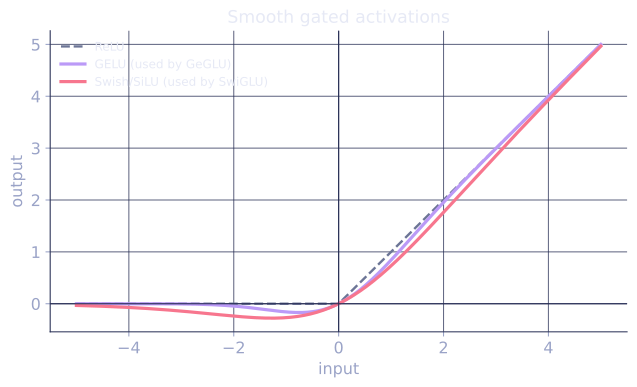
Swapping the gate nonlinearity gives the named variants. With the Swish (also called SiLU) function :
With the Gaussian error linear unit , where is the standard normal CDF:
The full block then applies a third matrix to project back to :
What the gate buys is per-coordinate control that a plain ReLU MLP cannot express. Take one hidden coordinate with value branch and watch the SwiGLU output as the gate pre-activation swings sign:
- Gate open. gives , so the coordinate passes through amplified: .
- Gate shut. gives , so the same value branch is squeezed to , near zero.
The value is identical in both rows; only the gate input differs, and it moves the output across a factor of twenty. A ReLU MLP would key the gate to the same coordinate's own sign; the GLU lets a separate projection decide, per coordinate, how much of the value to let through.
3. The 2/3 width rule
The gated FFN uses three weight matrices instead of two, so a naive swap at raises the parameter count by 50%. To compare architectures at equal size, shrink the hidden width. The gated count is
Setting and solving:
The new hidden width is two-thirds of the old one. This is why LLaMA reports (rounded to a convenient multiple) rather than : it holds parameters and FLOPs fixed so the gain is attributable to the gating, not to extra capacity.
4. Worked check
The block below builds a ReLU FFN and a parameter-matched SwiGLU FFN, confirms their parameter counts agree, and runs one forward pass.
import numpy as np

def swish(z):
    return z / (1.0 + np.exp(-z))

d = 512
d_ff_relu = 4 * d
d_ff_glu = (8 * d) // 3        # the 2/3 rule, rounded down

# baseline ReLU FFN
W1 = np.random.randn(d_ff_relu, d) * 0.02
W2 = np.random.randn(d, d_ff_relu) * 0.02
relu_params = W1.size + W2.size

# parameter-matched SwiGLU FFN (three matrices)
Wg = np.random.randn(d_ff_glu, d) * 0.02   # value branch
Wv = np.random.randn(d_ff_glu, d) * 0.02   # gate branch
Wo = np.random.randn(d, d_ff_glu) * 0.02
glu_params = Wg.size + Wv.size + Wo.size

x = np.random.randn(d)
relu_out = W2 @ np.maximum(0.0, W1 @ x)
glu_out = Wo @ ((Wg @ x) * swish(Wv @ x))

print("ReLU FFN params:  ", relu_params)
print("SwiGLU FFN params:", glu_params)
print("ratio:", round(glu_params / relu_params, 3))
print("output shapes:", relu_out.shape, glu_out.shape)
The two parameter counts land within rounding of each other (ratio near 1.0), so any loss difference between the architectures is a difference in form, not in size.
Exercises
Exercise 1. With Swish defined as , compute the SwiGLU output of one hidden coordinate whose value branch is , for gate inputs and . (, .)
Solution
Step 1. Evaluate the gate. With the gate open,
With the gate shut,
Step 2. SwiGLU multiplies the value branch by the gate, :
Step 3. The value branch is in both cases; only changed sign, and the output swings from to near zero. A separate projection controls how much of each coordinate passes, which a plain ReLU MLP cannot express per-coordinate.
Exercise 2. Derive the 2/3 width rule. A baseline ReLU FFN with hidden width has two weight matrices; a gated FFN has three. Find the gated hidden width that holds the parameter count fixed.
Solution
Step 1. Ignoring biases, the ReLU FFN costs .
Step 2. The gated FFN has three matrices of size (or its transpose), so .
Step 3. Set the costs equal and solve for :
The gated hidden width is two-thirds of , which is why LLaMA reports : it matches parameters and FLOPs so any gain is attributable to the gating, not extra capacity.
Exercise 3 (code). Build a ReLU FFN at and a SwiGLU FFN at the 2/3 width, and confirm their parameter counts agree within rounding (ratio close to ).
Solution
import numpy as np

d = 512
d_ff_relu = 4 * d
d_ff_glu = (8 * d) // 3          # 2/3 rule, rounded down -> 1365

# ReLU FFN: two matrices of size d x d_ff
relu_params = 2 * d * d_ff_relu
# SwiGLU FFN: three matrices of size d x d_ff'
glu_params = 3 * d * d_ff_glu

ratio = glu_params / relu_params
assert d_ff_glu == 1365                    # floor(8*512/3)
assert abs(ratio - 1.0) < 0.01             # matched within rounding
print("relu", relu_params, "glu", glu_params, "ratio", round(ratio, 4))
The two counts differ only by the floor in , so the ratio sits at about : the gated block spends the same budget as the ReLU block, isolating the effect of gating.
Next, multi-head latent attention attacks the other half of the block, compressing the attention KV cache the same way this lesson reshaped the FFN.
References
- [1]Shazeer, N. (2020). "GLU variants improve transformer (SwiGLU/GeGLU)". arXiv:2002.05202↩